Indoor vs outdoor sport climbing: How climbing walls, towers and rock faces differ – Part 1
Sport climbing is often described as either indoor or outdoor climbing. That sounds simple, but the real difference is not only where the climbing happens. The most important difference is the type of wall being climbed.
A climber may climb on an indoor artificial wall, an outdoor artificial climbing wall or tower, or a natural rock face. All three can be used for sport climbing, and all three can offer excellent movement, training and challenge. However, the walls themselves are very different. Their structure, surface, durability, maintenance, safety systems and route-setting possibilities all shape the climbing experience.
Understanding these differences is important for climbers, gym owners, route setters, schools, municipalities and anyone planning a climbing facility.
Three main types of sport climbing walls
Sport climbing walls can generally be divided into three categories.
The first category is the indoor artificial climbing wall. This is the typical climbing gym wall: an engineered structure built inside a controlled environment. It usually consists of panels, frames, bolt-on holds, volumes and fixed anchor systems.
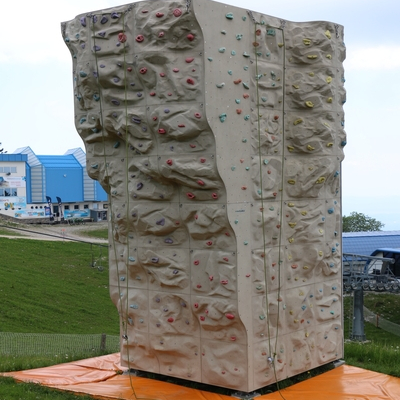
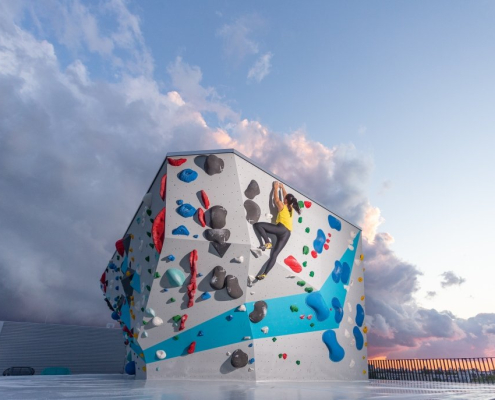
The second category is the outdoor artificial climbing wall or tower. These structures are also engineered, but they are installed outside. They may be freestanding climbing towers, school climbing walls, public park climbing structures, outdoor training walls, competition walls, adventure park towers or exterior walls attached to buildings.
The third category is the natural outdoor rock wall. This is a cliff, crag, cave, slab or rock face shaped by geology rather than design. It may be equipped with bolts and anchors for sport climbing, but the wall itself remains natural.
The difference between these three wall types is the foundation of the whole climbing experience.
Indoor climbing walls: controlled, flexible and route-setter driven
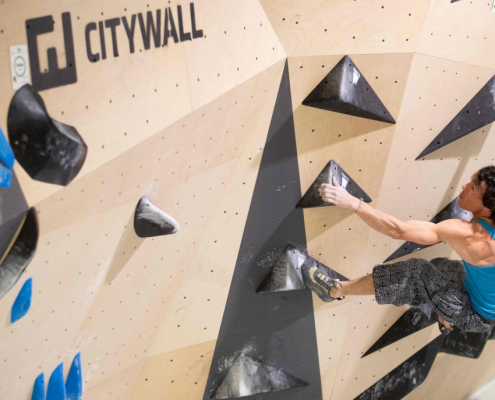
Indoor climbing walls are designed for control. The angle, height, structure, fall zone, hold placement and route layout are all planned. The environment is protected from rain, wind, direct sun, frost and most temperature extremes.
This gives indoor climbing several major advantages. Routes can be changed regularly. Holds can be cleaned, replaced or repositioned. Wall angles can be designed to support beginners, intermediate climbers, advanced training and competition-style movement. Safety systems can be inspected in a predictable environment.
Indoor walls are also highly flexible. A single facility can include slabs, vertical walls, overhangs, roofs, cracks, aretes, volumes and training boards. Route setters can create specific movement styles: technical slabs, endurance routes, powerful overhangs, coordination sequences or lead-climbing circuits.
Because the wall is artificial and the holds are deliberately placed, indoor sport climbing is usually easier to read. The route is often color-coded, the line is clear, and the difficulty is shaped by the route setter. This makes indoor climbing especially useful for structured training and progression.
The main limitation is that indoor walls do not fully reproduce the complexity of outdoor conditions. The surface is more predictable, the holds are designed for climbing, and the environment is controlled. This is exactly what makes indoor climbing practical, but it also makes it different from outdoor climbing.