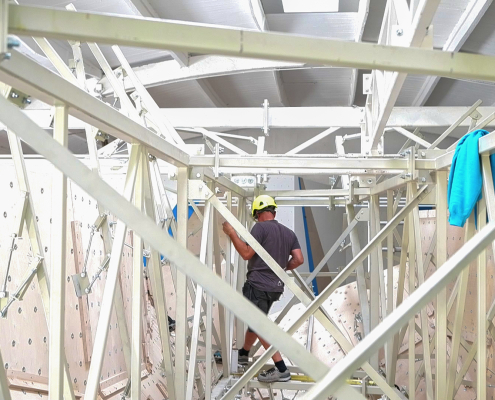
Why Engineered Timber Is a Smart Choice for Modern Climbing Wall Construction
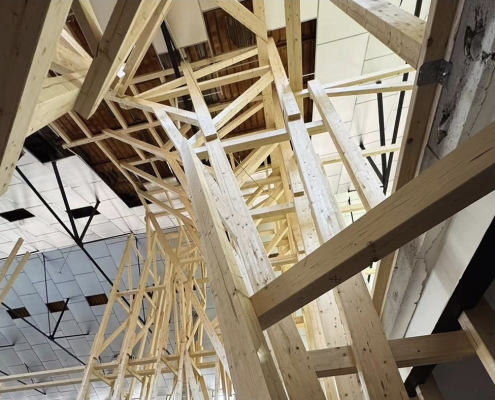
When planning a new climbing gym or commercial climbing wall, one of the most important decisions happens long before the first climbing hold is installed: choosing the right structural system.
Steel has traditionally been used for many climbing wall structures, particularly in North America. But there is another proven solution increasingly relevant to architects, investors, contractors and climbing gym owners: engineered timber.
We use engineered timber as a structural solution for climbing walls because it combines structural performance, efficient installation, adaptability and sustainability. For many projects, it can also contribute to lower overall project costs compared with conventional steel construction.
What Is an Engineered Timber Climbing Wall Structure?
Engineered timber should not be confused with ordinary construction lumber.
Our climbing wall structures use two main engineered wood products:
KVH structural timber is kiln-dried, strength-graded structural lumber used to create the main framework of the climbing wall.
BSH, or glulam (glue-laminated timber), consists of bonded timber laminations engineered to create strong structural beams capable of carrying significant loads and spanning larger distances.
A useful comparison is the construction of a building.
KVH forms the structural framework, while glulam provides the larger load-bearing backbone of the structure.
Together, they allow engineers to create complex commercial climbing structures ranging from compact bouldering facilities to large lead climbing walls.
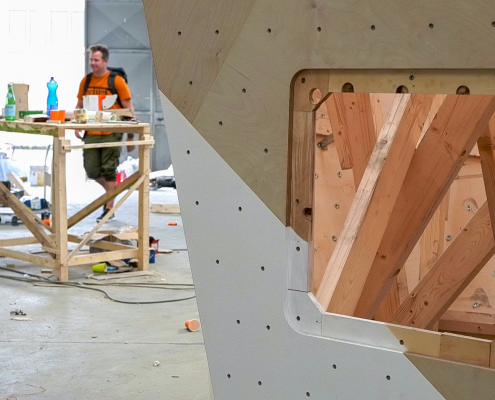
Engineered Timber vs Steel for Climbing Walls
Both steel and engineered timber can provide the structural performance required for commercial climbing facilities when they are correctly engineered.
The key question is therefore not simply:“Is timber strong enough?” The more useful question for an investor, architect or climbing gym operator is:
“Which structural system makes the most sense for this specific project?”
Engineered timber offers several advantages that can make it particularly suitable for climbing wall construction.
- Potentially Lower Overall Project Costs
The cost of a climbing wall structure goes beyond the price of the raw material.
Fabrication, transport, installation, equipment requirements, labour and possible on-site modifications all influence the final project cost.
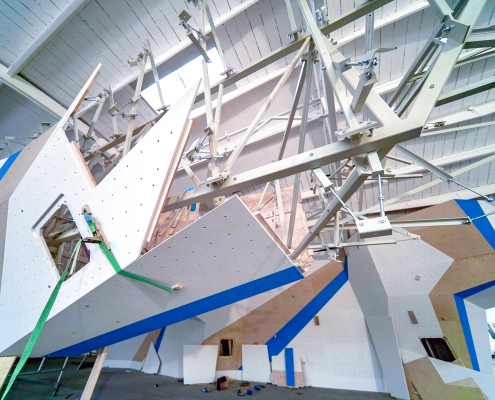
Engineered timber can simplify several of these stages. Components can be precisely manufactured in advance and assembled efficiently on site without the welding and metal fabrication processes associated with many steel structures. For developers and climbing gym investors, this can help reduce the overall complexity and cost of the structural package.
- Faster and More Efficient Installation
Construction time matters. Every additional week before a new climbing centre opens can affect labour costs, project schedules and the date when the facility begins generating revenue.
Engineered timber components have an excellent strength-to-weight ratio, making them comparatively easy to transport, handle and assemble. Because the system does not depend on extensive on-site welding, installation can also be more straightforward.
The result is a structural solution designed around efficient manufacturing and fast on-site assembly. For contractors and investors working with tight construction schedules, this can be a significant advantage.
- Greater Flexibility for Future Changes
Climbing gyms are rarely static. Routes change constantly, but over time the facility itself may also need to evolve.
Operators may want to:
- expand the climbing area,
- modify wall geometry,
- renovate an existing section,
- introduce a new training zone,
- or adapt the facility to changing customer needs.
Engineered timber structures can provide greater flexibility for these types of modifications because many adjustments can be performed using conventional carpentry methods. That adaptability can become particularly valuable over the long lifetime of a commercial climbing facility.
- Fire Safety: Understanding Timber and Steel Performance
Fire safety needs to be addressed as part of the overall building design. Two different concepts matter: reaction to fire, which concerns a material’s contribution to fire development, and fire resistance, which includes a structural element’s ability to maintain its load-bearing function during fire exposure.